1. The Importance of Commercial Interior Design in Bangalore
Bangalore’s swift emergence as an international startup and business hub has created a huge need for commercial spaces that are professionally designed. With IT companies, coworking spaces, and brick-and-mortar chains sprouting everywhere in the city, businesses are learning that interiors are no longer merely aesthetic—they have a direct influence on productivity, brand image, and consumer interaction.
When it comes to commercial interior designers in Bangalore, they help design office spaces and stores that support business goals. Be it sleek workspaces or boutique stores, expert interior design delivers smart space solutions and lasting adaptability. But unlike ad hoc interiors, professional design provides clarity of implementation, budget management, and adherence to safety standards. In such a fiercely competitive market as Bangalore, great commercial interiors are not an indulgence anymore but a strategic imperative.
2. Importance of Commercial Interior Designers in Contemporary Workspaces
Commercial interior designers deal with much more than aesthetics. From end-to-end design development, technical planning, and on-ground execution. Beginning with business acumen, designers develop plans to optimize workflow, access, and efficiency.
They coordinate closely with the architects, MEP consultants, contractors, and material vendors. Fire safety, building codes, and accessibility compliance are particularly important tasks in office and retail spaces.
And commercial interior designers in Bangalore also handle project budgets and timelines, assisting companies in steering clear of cost overruns and delays. Their disciplined process guarantees that design vision becomes reality, providing well-crafted and long-lasting spaces customized for commercial application.
3. Office Interior Design: Building Efficient Work Environments
3.1 Space Planning for Productivity
Smart space planning is the foundation of effective office interior design. Designers evaluate team size, workflow, and expansion needs to determine whether to use open workstations or private cabins. Meeting rooms, collaboration zones, and breakout areas are arranged to facilitate collaboration without disturbing concentration. Acoustic planning is key, employing partitions, ceiling treatments, and soft finishes to manage noise in hectic offices.
3.2 Ergonomics and Employee Comfort
Comfort impacts performance and retention. And ergonomic furniture—like adjustable chairs and workstations—minimizes physical stress after extended work sessions. Well-designed lighting reduces eye strain and encourages well-being through natural light. Proper ventilation and indoor air quality planning guarantee a healthy workspace, turning office interior design into a long-term investment in employee productivity.
4. Retail Interior Design: Enhancing Customer Experience
Retail interiors are meant to direct customer behavior and maximize sales. Retail interior designers meticulously design store circuits for efficient customer circulation, so you can effortlessly browse and discover new products. High-end product located in focal areas with accent lighting.
Visual merchandising, display units, and signage combine to strengthen brand identity. We’ve found checkout counter placement is a great way to control queues and eliminate congestion. Using careful material, lighting, and space choices, our retail interiors weave a brand’s narrative while crafting a compelling and comfortable shopping experience that invites visits again and again.
5. The Design Process of Commercial Interior Designers
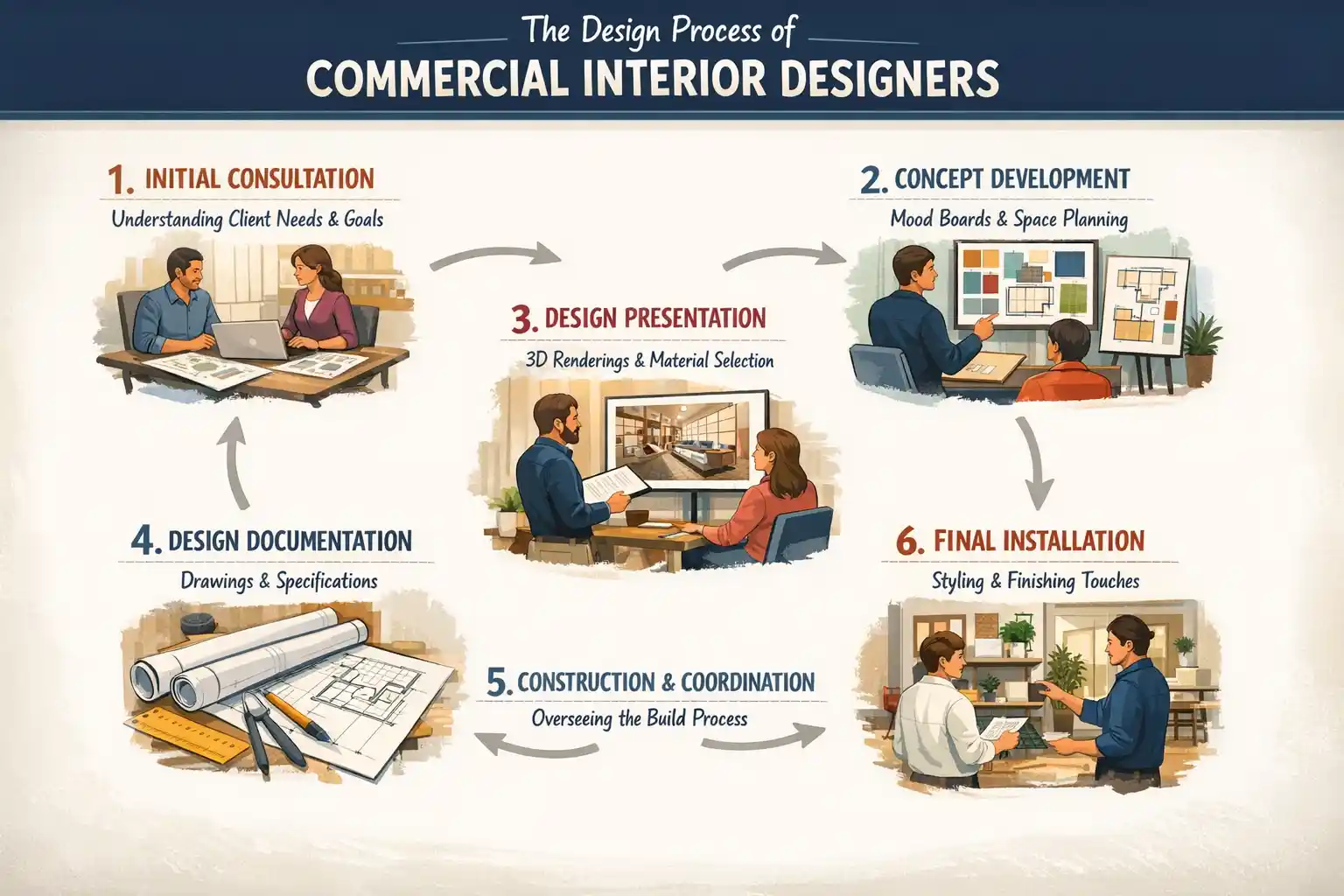
The commercial interior design process starts with a comprehensive requirement analysis of business objectives, operational needs, and budget constraints. Designers then make on-site assessments and measurements to discover spatial limitations and possibilities.
Concept development involves layout and 3D visualizations so clients can get a clear idea of what the design will look like. Material selection and cost calculation come next, making certain it’s both durable and worth the price. Execution planning is almost always phased to avoid making a mess and with ongoing supervision, quality, and timelines through delivery of the project.
6. Budget Interior Office and Retail Design
Low-budget interior design doesn’t mean making sacrifices. They’re smart; they focus on space efficiency, which means fewer wasteful build-up areas and lower construction costs. Modular furniture, prefabricated partitions, and standardized finishes all assist in keeping costs manageable while maintaining agility.
Smart materials like laminates, engineered boards, and abrasion-resistant vinyl flooring deliver long-lasting performance at affordable prices. Phased execution enables companies to focus on their most critical areas initially and extend later. By concentrating investments in high-impact zones such as receptions or customer displays, low-budget interior design yields powerful visual and functional dividends.
7. Small Space Planning: What Small Apartment Interior Designers Can Teach Us
Small apartment interior design principles are creeping into small offices and shops. Space-saving furniture, wall-mounted storage, and multi-functional zones help maximize limited floor areas. Designers bring residential ideas of vertical storage, foldables, and built-in cabinetry into the commercial space.
Visual tactics such as lighter color schemes, reflective surfaces, and layered lighting trick the eye into perceiving more space. All of these studio apartment interior design ideas maximize efficiency, minimize clutter, and make even the tiniest retail space feel airy and well-organized—without adding a single square inch.
8. Technology Integration in Commercial Interiors
Today’s business spaces demand integrated technology. Smart lighting not only increases energy efficiency but also enables automated control based on occupancy. Organized data cabling provides solid IT infrastructure for office and retail point-of-sale systems.
Conference rooms and retail spaces integrate AV solutions like video conferencing, digital signage, and interactive displays. Access control, CCTV, and security planning—all worked invisibly into the design. Commercial interior designers guarantee future-ready infrastructure that supports scale.
9. Branding and Identity via Commercial Interior Design
Interior design is branding at its best. Designers translate brand values into concrete elements through color psychology, materials, and layouts. Offices project company culture through collaborative spaces, and retail interiors amplify brand positioning through visual storytelling.
Custom signs, wall graphics, and branded design accents provide continuity across locations. A beautifully crafted commercial space enhances brand memorability and fosters loyalty in your employees, customers, and stakeholders.
10. Typical Problems in Commercial Interiors

Commercial projects tend to be pressed for time because they’re part of an active business. Budget constraints and mid-project scope changes can affect execution if not handled professionally. Regulatory approvals and compliance requirements can also cause delays, particularly in busy commercial buildings.
It’s also hard to coordinate multiple vendors and keep up quality. Seasoned commercial interior designers reduce these risks with careful scheduling, detailed communication, and implementation in phases to lessen impact on the day-to-day during a fit-out or remodel.
11. How to Select the Best Commercial Interior Designers in Bangalore
And as we all know, choosing the right design partner can be make-or-break for a project. Companies should judge designers by previous office and retail projects. Looking at portfolios, case studies, and execution capabilities helps you understand their pragmatic expertise.
Transparency in costing, timelines, and scope is realistic. Dependable after-completion support guarantees a trouble-free transition and enduring success. The right commercial interior designers in Bangalore are collaborators, not vendors.
12. Why commercial interior designers are a smart investment if you want to grow your business
Professional commercial interiors impact productivity, customer experience, and brand perception. Designing mindfully gets you both efficiency and happy employees and happy sales.
Bangalore commercial interior designers add technical expertise, cost controls, and strategic planning to help craft scalable business environments. When interior design meets business strategy, you get long-term ROI and sustainable growth. To invest in professional commercial interiors is more than a design choice; it’s a business decision