1. Why Kitchen Design Decisions Matter
In most Indian homes today, the kitchen is no longer a hidden utility space. It is where families cook, talk, pack tiffins, experiment with new recipes, and often even work from home. When you spend so many hours here every day, the way your kitchen is planned affects everything: comfort, storage, cleaning time, and even how much you enjoy cooking. That is why kitchen design decisions cannot be treated as just “carpenter work.”
Homeowners now have two clear choices: ready-planned modular kitchen designs or fully custom, site-built kitchens. Each approach has its own pros and cons in terms of budget, speed, durability, and creative freedom. At Suntew, we see many clients confused between the two, especially in apartments and new villas.
This guide breaks down modular and custom kitchens in simple language so you can decide what actually suits your home, family, and cooking style instead of only following trends or showroom pictures. A well-planned kitchen becomes a daily support system, not a headache.
2. Overview of Contemporary Kitchen Design Approaches
Kitchen design in Indian homes has changed a lot in the last 10 to 15 years. Earlier, the focus was only on a strong platform and basic storage. Today, families look for smart modular kitchen designs, planned movement space, and easy cleaning. The kitchen is closely linked to the way you live, cook, and entertain at home.
Open and semi-open kitchens are typical in flats; the kitchen’s design must complement the living and eating spaces. Many villa owners desire both a functional kitchen for heavy cooking and a show kitchen. In both situations, daily comfort is greatly impacted by the thoughtful design of the stove, sink, refrigerator, tall units, and corner storage.
The goal of modern kitchen design is to strike a balance between appearance and functionality. Good design is not just about what appears good in pictures or catalogues; it also takes into account the available space, your cooking style, the number of family members, and your budget.
3. Understanding Modular Kitchen Designs in Detail
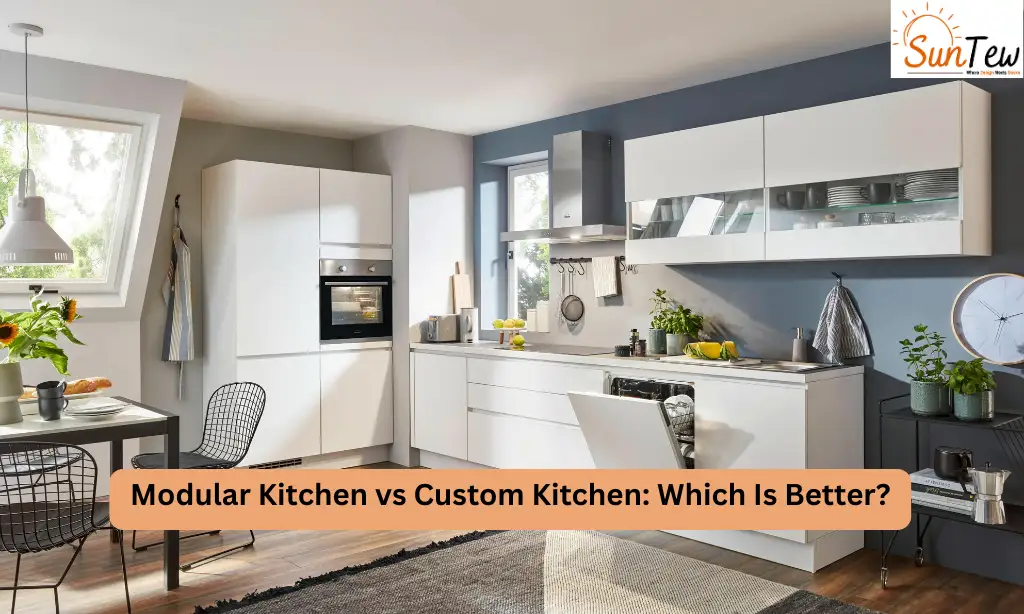
A modular kitchen is built using ready-made, factory-finished units that fit together like blocks to form your full kitchen. Instead of building everything on-site, you get a planned set of base units, wall units, tall units, corner units, and lofts that are designed to work in a coordinated way. This is why modular kitchen designs are neat, organized, and easy to repeat in apartments and villas.
Each cabinet follows standardized sizing for width, height, and depth. For example, hob units, sink units, corner units, and drawers have typical measurements that match most appliances. Because these modules are produced in a factory, the cutting and finishing are more precise than regular on-site carpentry. This also helps in faster installation and easier repairs later.
From a modular kitchen interior design point of view, the look is created by combining different finishes like laminates, acrylic, PU, or glass, along with matching handles, skirting, and lighting. You can choose straight, L-shaped, U-shaped, or island kitchens depending on your space. Internal accessories, pull-outs, bottle pull-outs, cutlery trays, and corner solutions further improve storage.
In short, a modular kitchen is a planned system where structure, sizing, and finishes are all coordinated before work starts at your home.
4. Understanding Custom Kitchen Planning
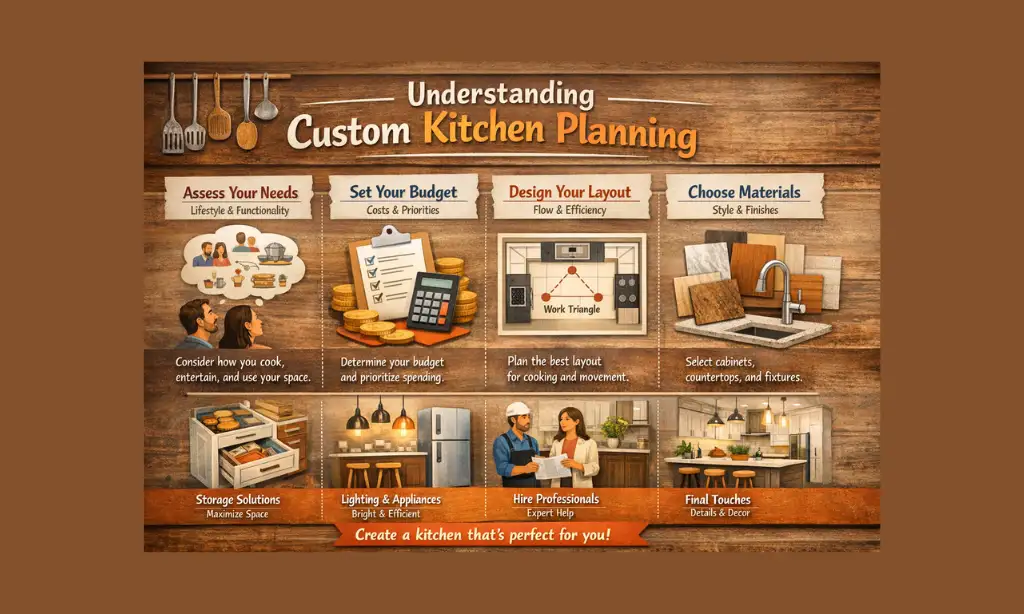
A custom, site-built kitchen is planned and executed directly at your home by carpenters, rather than assembled from factory-made modules. The basic structure is usually created using plywood, blockboard, or masonry, finished with laminate, veneer, PU, or other surface materials. Everything from cabinet sizes to shelf heights is measured and decided on site to suit your exact walls and requirements.
Here, carpentry and bespoke detailing play a big role. If you have heavy Indian cooking, your platform height, chimney capacity, and storage for big vessels can be customized. If you are tall, the counter can be slightly higher. If you want a pooja shelf, breakfast counter, display niches, or curved corners, the carpenter can build them to your taste, as long as the design is technically sound.
Custom kitchens are also useful in homes with unusual layouts. For example, if you have sloping ceilings, odd columns, very small utilities, or combined kitchen-utility spaces, a standard modular grid may waste space. With custom kitchen design ideas, the designer and carpenter can plan deep pull-outs, extra lofts, foldable counters, or built-in seating that responds to your actual lifestyle.
In short, a custom kitchen is like a tailored outfit: more work, but made specifically for your family and your home.
5. Layout Planning and Workflow Efficiency
In any busy Indian kitchen, how you move between the hob, sink, and fridge decides how tiring cooking feels. This basic “work triangle” is the heart of kitchen ergonomics. If these three points are too far apart or blocked by corners, every meal prep becomes extra walking and bending.
With modular kitchens, layouts like straight, L-shaped, U-shaped, and parallel counters are pre-studied for good workflow. Designers fit ready-made modules into these patterns, keeping enough walkway space and placing tall units at the right ends, so daily tasks stay smooth.
Custom kitchens, on the other hand, give you more layout freedom when your room shape is unusual. You can slightly shift counters, add a breakfast ledge, merge utility space, or create special zones for baking or bulk storage. The key is to respect basic ergonomic rules even when experimenting.
A well-planned layout, modular or custom, ensures one person can cook comfortably while another can still enter, serve, or clear without bumping into cabinets and appliances.
6. Kitchen Furniture Design and Cabinet Construction
Your kitchen furniture is not just about looks. The way cabinets are built decides how strong, quiet, and organized your kitchen feels after years of use.
In both modular and custom kitchens, you usually have three main cabinet types: base units under the counter, wall units above the counter, and tall units for pantry or appliances. Inside these, you can choose shelves, drawers, and pull-outs depending on what you store. Drawers are great for daily utensils and cutlery, while deep pull-outs work well for grains, oil tins, and masalas.
Shutters are finished in laminate, acrylic, PU, or veneer, with edge banding to protect corners. Good-quality hinges, soft-close channels, and lift-up fittings are very important. Cheap hardware may work initially but tends to sag, make noise, or get damaged with heavy Indian cooking. At Suntew, we always recommend branded hardware that can handle daily use.
For smarter kitchen furniture design, we use organizers, corner solutions, bottle pull-outs, tray holders, and vertical partitions so that every inch of space is used properly. This reduces clutter on the counter and makes it easy to find what you need even on a busy morning.
7. Material Selection and Finish Options
Material choice is one of the biggest factors behind how long your kitchen will last and how it will look after a few years of cooking, steam, and cleaning.
In modular kitchen designs, the core structure is usually made from BWR or BWP plywood, HDHMR, or sometimes particle board or MDF in budget ranges. Since these are factory processed, cutting and edge banding are very uniform, which improves finish consistency. Front finishes can be laminate, acrylic, membrane, PU paint, glass, or a mix of textures. This gives you many color combinations, from matte earthy tones to high-gloss modern looks.
In custom kitchens, materials are selected and worked on directly at the site. The base is commonly marine or commercial plywood with laminate, veneer, or PU on top. A skilled carpenter can create special grooves, moldings, and traditional details that are harder to achieve in standard modular shutter profiles. However, the final finish depends a lot on workmanship, sanding, and polishing quality.
For durability, we usually suggest moisture-resistant boards near sink areas, proper edge sealing, and good-quality laminates or PU. When these basics are correct, both modular and custom kitchens can handle daily Indian cooking for many years.
8. Installation Process and Timeline Comparison
One of the biggest practical differences between modular and custom kitchens is the time taken and the disturbance at home.
With a modular kitchen, most of the work happens in the factory. Cabinets are cut, finished, and packed before they come to your house. At the site, our Suntew team mainly has to fix the carcass, align shutters, install hardware, and adjust appliances. For a normal apartment kitchen where civil work is ready, installation usually takes just a few days, so dust and noise are limited.
In a custom, site-built kitchen, construction starts from the raw stage. Cutting, framing, fixing, laminating, and finishing all happen inside your home. This means more carpenters on-site for a longer period, more dust, and more coordination with other civil works. The total timeline can stretch to a few weeks, especially if polishing or detailed work is involved.
9. Cost Factors That Influence Kitchen Budgets
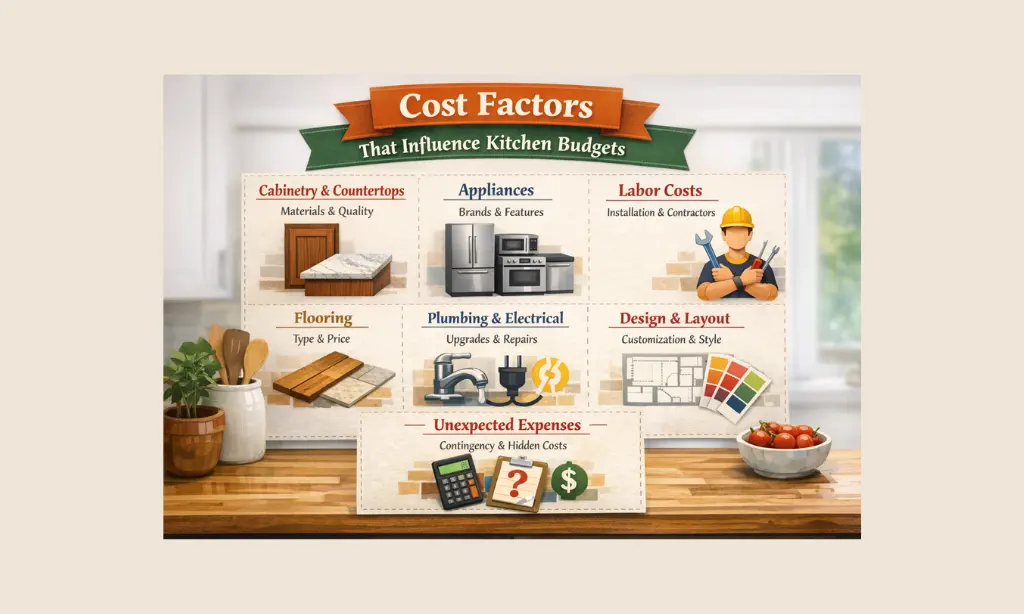
When clients ask, “How much will my kitchen cost?” There is no single rate. Both modular and custom kitchens are influenced by a set of practical factors that add up line by line.
For modular kitchen designs, pricing is usually calculated per running foot or per square foot of cabinets. The main cost drivers are:
- Core material (MDF/particle board vs HDHMR/BWR/BWP plywood)
- Shutter finish (standard laminate vs acrylic, PU, veneer or glass)
- Hardware brand and type (soft close, corner systems, tall units, accessories)
- Layout size, height of lofts and number of drawers or pull-outs
In a custom, site-built kitchen, labor plays a bigger role. Carpenters charge based on time and complexity, and there is often more material wastage on site. Detailed grooves, curves, veneer work, or hand polishing will push the budget up, even if the visible area looks small.
When you see “price custom kitchen design ideas” online, remember these are only broad ranges. Actual cost depends on your room size, chosen materials, hardware level, and any civil changes like breaking walls or shifting plumbing.
At Suntew, we usually start by fixing a realistic budget range with you, then tune finishes and accessories up or down so that the kitchen stays beautiful without shocking you at the final bill.
10. Maintenance, Repairs, and Replacement Ease
In real life, your kitchen has to handle spills, steam, heat, and busy mornings. So it is important to think about how easy it is to maintain and repair, not just how it looks on day one.
In a modular kitchen, one big advantage is module replacement. If a cabinet gets damaged or a shutter swells, the affected unit can usually be removed and replaced without disturbing the full kitchen. Hardware like channels and hinges is also standardized, so getting matching parts after a few years is simpler.
With a custom, site-built kitchen, repairs depend more on the original carpenter and the material used. Small issues like loose hinges or laminate edges can be handled, but if there is major water damage or you want to change the layout, the work can become messy and time-consuming.
11. Visual Appeal and Design Consistency
Visual appearance is often the first thing people notice when they walk into a kitchen. Here, modular and custom approaches offer two slightly different kinds of beauty.
In modular kitchen designs, every cabinet is planned as part of a coordinated set. Lines are straight, gaps are controlled, and finishes repeat in a clean, uniform way. This is ideal if you like a modern, minimal look where the kitchen quietly matches the rest of your home interiors. It also makes future additions easier, because new units can be matched with the existing style.
In a custom kitchen, there is more scope for artistic freedom. You can mix different shutter styles and create open niches, arches, fluted panels, or classic mouldings that reflect your personal taste. Colors and textures can be layered more boldly, especially in larger villas. The only condition is that detailing must be executed carefully, or the kitchen can look busy instead of elegant. At Suntew, we help you balance creativity with long-term visual comfort.
12. Customisation Limits vs Creative Freedom
Both modular and custom kitchens offer “customization,” but in different ways. In a modular kitchen, you can choose colors, finishes, handles, accessories, and the overall layout from a defined set of options. Within that grid, there is good flexibility, but core sizes and cabinet structures remain standard. If you want an unusual curve, very deep counters, or non-standard appliance niches, the system can start to struggle or become more expensive.
In a custom kitchen, almost every detail can be shaped around your ideas: special pooja corners, hidden niches, extra-high lofts, built-in seating, display shelves, or mixed traditional and modern detailing. This gives strong creative freedom, especially when you have a clear vision or a designer working with you. The key is to balance imagination with practicality, so the kitchen stays easy to use and clean on a daily basis.
13. Suitability Based on Home Type
The right kitchen approach also depends on the type of home you live in.
In apartments, space is usually compact, walls are straight, and most units in the project share similar layouts. Here, modular kitchen designs work very well. Standardized cabinets fit neatly into typical L or parallel layouts, installation is quick, and there is less disturbance to neighbors. If you ever plan to rent or resell, a clean modular kitchen is a strong plus point.
In villas and independent homes, you generally have more freedom to play with space. Many owners prefer a mix of a show kitchen and a heavy-duty working kitchen or want large islands, breakfast counters, and niche storage. In such cases, a custom kitchen or a hybrid of modular plus site-built elements can respond better to unique wall conditions and lifestyle needs. At Suntew, we often blend both approaches for such homes.
14. Long-Term Value and Lifestyle Fit
In the long run, the best kitchen is the one that matches how you actually live and cook every day. If your family cooks full meals twice a day, uses heavy utensils, and stores bulk groceries, you need a strong structure, planned ventilation, and deep, accessible storage. Here, both good modular kitchen designs and thoughtfully built custom kitchens can work, as long as materials and hardware are chosen correctly.
If your cooking is lighter, you travel often or order food frequently, you may value easy cleaning, open counters, and a clean, minimal look more than maximum storage. Families with growing children may need flexible space for lunch boxes, snacks, and changing routines, while elderly parents benefit from less bending and better lighting.
Thinking honestly about your usage patterns and future lifestyle helps you pick a kitchen that ages well with your home.
15. Modular Kitchen vs Custom Kitchen: Quick Comparison Summary
Modular and custom kitchens both aim to give you a comfortable, efficient cooking space, but they reach that goal in different ways. Here is a quick side-by-side view:
- Design: Modular kitchen designs are clean and uniform; custom kitchens allow more artistic detailing.
- Cost: Modular has clearer, pre-estimated pricing; custom depends more on labor and complexity.
- Time: Modular installation is quicker with less disturbance; custom carpentry normally takes longer on site.
- Maintenance: Modular units are easier to repair or replace by module; custom kitchens may need more work for big changes.
- Future changes: Modular systems accept add-ons smoothly; custom kitchens can be altered, but with extra on-site work.
This summary helps you quickly see which approach fits your home and budget better.
16. How to Decide the Right Kitchen for Your Home
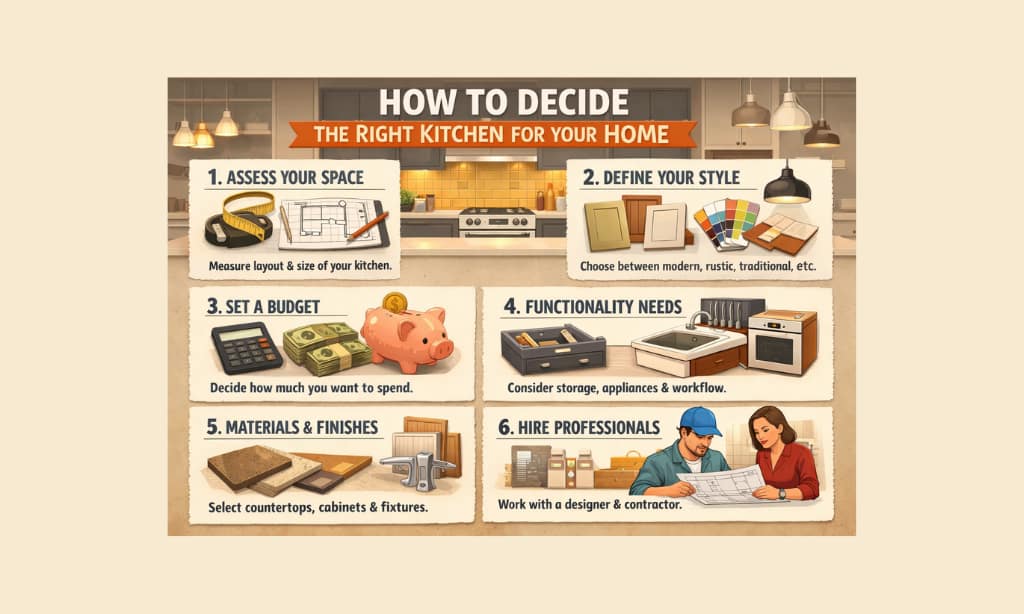
When you stand between modular and custom options, start with three simple checkpoints: budget, space, and time. First, be honest about how much you are ready to invest now and what level of finishes you really need. Good modular kitchen designs can be tuned to different budgets by adjusting materials, hardware, and accessories, while fully custom work may stretch costs if detailing is heavy.
Next, study your space and structure. In regular apartment layouts, a well-planned modular kitchen interior design usually gives you everything you need with less disturbance. In very unusual rooms, older homes, or villas, custom kitchen design ideas or a hybrid model may use awkward corners and extra height better.
Finally, think about your timeline. If you want a quick, predictable installation with less dust, modular is safer. If you have more time, patience, and a strong design vision, custom may be worth the extra effort. Suntew can also help you compare both options with real drawings and budgets.
17. Conclusion: Making the Right Kitchen Investment
Choosing between a modular kitchen and a custom kitchen is not about which option is “best” in general, but which one fits your home, budget, and lifestyle better. If you want clean finishes, predictable timelines, and less disturbance, modular kitchen designs are usually the safer path. If your space is unusual or you have a very specific visual idea, a well-detailed custom kitchen or a hybrid solution can be the right answer.
Look at how you cook, how long you plan to stay in the home, and how much flexibility you really need. From there, fine-tune materials, hardware, and accessories instead of cutting corners blindly. At Suntew, our role is to help you compare, plan, and execute a kitchen that feels right every single day.